Scale from 1K to 100K Subscribers with the OutlierKit 3-Phase Scaling System
Use OutlierKit's full suite of 5 research tools, UTubeKit, and YouTube Studio to run a data-driven growth system from your first 1,000 subscribers all the way to 100K. OutlierKit is built for experts, consultants and coaches who teach on YouTube, whether they run the channel or an agency does.
100K puts a channel well above typical. The subscriber benchmarks across 20 niches rank 112,562 active channels, and the median channel has under 35K subscribers in every niche. The system below slots into the wider YouTube growth strategy playbook.
TL;DR
- Phase 1 (Foundation, 1K to 10K) builds search traffic from long-tail keywords with 500 to 5K monthly searches and studies channels with 5K to 20K subscribers.
- Phase 2 (Momentum, 10K to 50K) finds outlier patterns and trending topics to earn algorithm recommendations.
- Phase 3 (Scale, 50K to 100K) targets your niche's main keywords, analyzes every upload and runs a repeatable research loop.
- With weekly uploads and real search demand, 12 to 24 months from 1K to 100K is a working estimate, not a guarantee.
- The most common plateau sits between 5K and 15K, where search traffic alone stops being enough.
Which channels scaled with this kind of system?
These four channels scaled past 100K. Each analysis shows their outlier videos, upload cadence and revenue estimates.
OutlierKit Channel Analysis

Ali Abdaal
Productivity & education
- Subscribers
- 6.6M
- Avg views
- 381.3K
- Total views
- 550.5M
OutlierKit Channel Analysis

Thewizardliz
Self-improvement
- Subscribers
- 8.5M
- Avg views
- 2.4M
- Total views
- 319.6M
OutlierKit Channel Analysis

Charisma on Command
Social skills & psychology
- Subscribers
- 7.1M
- Avg views
- 1.9M
- Total views
- 829.0M
OutlierKit Channel Analysis

Productive Peter
Productivity (faceless)
- Subscribers
- 527.0K
- Avg views
- 76.8K
- Total views
- 24.7M
Stats are from our most recent snapshot of each channel. For live numbers, outlier videos, and up-to-date revenue estimates, run a fresh analysis on OutlierKit →
3 Phases
Foundation, Momentum, Scale
1K → 100K
Systematic subscriber growth
All 5 Tools
Five OutlierKit research tools
Data-Driven
Every decision backed by research
Why do channels stall after 1,000 subscribers?
Many creators stall after their first 1,000 subscribers. Passion and hustle got them the first traction, but scaling past it takes a different approach. These problems compound:
- No systematic strategy, just random uploads and hoping something goes viral
- Competing for keywords and topics they can't win yet
- No idea which content drives subscriber growth vs. just views
- Plateaus at 5K, 10K, or 30K with no clear path to break through
- Burnout from posting frequently without seeing proportional growth
The creators who reach 100K work differently at each stage, using the right tools and strategies for their current subscriber level.
How does the 3-phase scaling system work?
The OutlierKit 3-Phase Scaling System, powered by OutlierKit's full suite of tools, UTubeKit, and YouTube Studio. Each phase introduces the right tools for your growth stage, so you're never using the wrong strategy for your subscriber count. Foundation builds your search base, Momentum gets you into algorithm recommendations, and Scale makes you an authority.
What changes before and after the system?
Growing Without a System
- Random topic selection with no data
- Same strategy at 1K and 50K subscribers
- Months-long plateaus with no way to diagnose why
- No optimization of existing content
- Burnout from effort without proportional results
3-5 years to maybe reach 100K
OutlierKit 3-Phase Scaling System
- Right strategy for each growth stage
- Data-driven topic selection at every level
- Break through plateaus with specific tools
- Continuous optimization of existing library
- Self-reinforcing research loop at scale
12-24 months, our estimate, with a system
100x
Subscriber growth
3 Phases
Adapts to your level
5 Tools
OutlierKit research suite
12-24mo
Estimated timeline
What are the 3 phases at a glance?
How do you run each phase step by step?
Each phase introduces the right tools for your subscriber level. Follow the phases in order. The strategies build on each other.
Phase 1: Foundation
1K → 10K Subscribers
Find Your Niche's Low-Competition Keywords
 OutlierKit Keyword Research
At 1K subscribers, you can't compete for high-volume keywords. Instead, use OutlierKit's Keyword Research tool to find low-competition, long-tail keywords in your niche: topics with real search demand but very few quality videos. These are the gaps that let small channels punch above their weight and build consistent search traffic from day one.
- Enter your niche topic into OutlierKit Keyword Research
- Filter for keywords with low competition scores
- Focus on long-tail phrases with 500-5K monthly searches
- Build a list of 20-30 keywords you can realistically rank for
- Prioritize keywords with high intent: viewers who want to learn or buy

Pro Tip: Target keywords with 3+ words. 'How to budget' is competitive; 'how to budget as a college student on minimum wage' is a goldmine for small channels. The longer and more specific the keyword, the less competition you face.
Study What Small Channels Get Right
OutlierKit Competitor AnalysisDon't study channels with millions of subscribers. Study channels that recently grew from 1K to 10K in your niche. OutlierKit's Competitor Analysis tool reveals what's actually working for channels at your level: their best-performing content, posting patterns, and the topics that drove their growth spurts.
- Search for channels in your niche with 5K-20K subscribers
- Use Competitor Analysis to see their top-performing videos
- Identify which topics drove their biggest subscriber spikes
- Note their posting frequency and content format patterns
- Find content gaps: topics they haven't covered well yet

Pro Tip: Look for channels that grew quickly, not channels that have been around forever. A channel that went from 2K to 15K in 6 months has more actionable lessons than one that took 5 years to reach 50K. Speed of growth indicates they found a working formula.
Build Search-Optimized Content
 UTubeKit
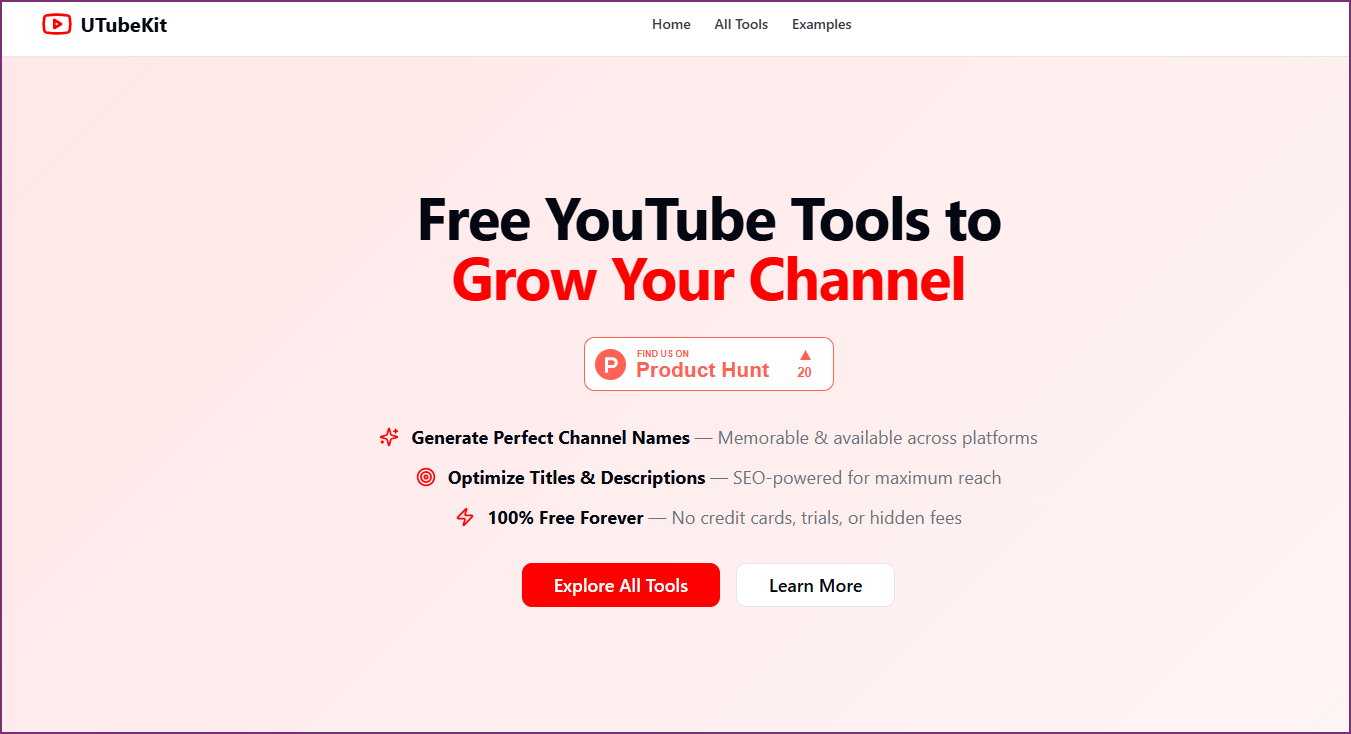
With your keywords and competitor insights in hand, use UTubeKit's free SEO tools to optimize every video for maximum search visibility. At the foundation stage, search traffic is your lifeline. It brings viewers who are actively looking for your content, even when you have zero algorithm momentum.
Choose your AI tool, exact prompt for each:
 ChatGPT· Best for generating multiple title variations and hooks
I'm a small YouTube channel (under 5K subscribers) in [your niche]. I'm making a video targeting the keyword: [your keyword from OutlierKit] OutlierKit's competitor analysis shows that top-performing videos on this topic use these patterns: [Paste competitor title patterns and angles] Generate: 1. 10 title options optimized for this keyword (front-load the keyword) 2. A 200-word description with the keyword in the first sentence 3. 15 relevant tags in order of importance 4. 3 hook ideas for the first 10 seconds Make titles specific and compelling for a small channel. Avoid clickbait that only works for big channels.
 Gemini· Best for data-driven SEO optimization and trend alignment
I'm optimizing a YouTube video for the keyword: [your keyword from OutlierKit] Here's what I know from OutlierKit research: - Keyword competition: [low/medium] - Monthly search volume: [number] - Top competitor videos: [paste titles and view counts] Create an SEO-optimized content plan: 1. Title (keyword in first 5 words, under 60 characters) 2. Description (keyword in first sentence, include 3 related keywords naturally) 3. Tags (20 tags from most to least relevant) 4. Optimal video structure for search intent (what viewers searching this keyword want to learn) 5. Suggested timestamps/chapters to increase watch time Focus on search optimization for a channel under 10K subscribers.
 Claude· Best for strategic content structuring and audience matching
I'm building a YouTube channel from 1K to 10K subscribers in [your niche]. I've used OutlierKit to find this low-competition keyword: [your keyword] Competitor data from OutlierKit: [Paste top-performing video titles and their view counts] Help me create a search-optimized video plan: 1. TITLE: Keyword-optimized, compelling for small channel (no misleading hooks) 2. DESCRIPTION: SEO-rich 300-word description with natural keyword placement 3. CONTENT STRUCTURE: Outline that maximizes watch time (intro hook → problem → solution → proof → CTA) 4. DIFFERENTIATION: How should my video be better/different than existing top results? 5. INTERNAL LINKING: How to use this video to funnel viewers to other content on my channel The goal is ranking on page 1 of YouTube search for this keyword within 30 days.
- Enter your target keyword into UTubeKit's SEO analyzer
- Generate optimized titles, descriptions, and tags
- Use UTubeKit's thumbnail analysis for click-through rate optimization
- Apply SEO best practices to every upload consistently
- Track which keywords are driving the most impressions
Pro Tip: At the foundation stage, every video should target a specific search keyword. Don't chase trends or make reaction videos yet. Build a library of searchable content that works for you 24/7. Search traffic compounds over time and forms the base of your channel.
Phase 2: Momentum
10K → 50K Subscribers
Find Outlier Patterns to Replicate
OutlierKit Outlier FinderAt 10K subscribers, you have enough of a foundation to start swinging for bigger hits. Use OutlierKit's Outlier Finder to discover videos in your niche that massively outperformed expectations. These reveal what the algorithm and audiences are hungry for right now. You're not copying these videos; you're identifying the patterns behind their success.
- Search your niche in Outlier Finder for videos with 10x+ outlier scores
- Analyze outlier titles for emotional hooks and curiosity gaps
- Identify topics that consistently produce outliers (not one-offs)
- Note which formats work: tutorials, listicles, comparisons, stories
- Build a content calendar around the top 10 outlier patterns you discover

Pro Tip: Focus on outliers from channels near your size (5K-50K subscribers). An outlier on a 20K-subscriber channel is a much stronger signal for you than one on a 5M-subscriber channel. It proves the topic works without requiring a massive existing audience.
Deep Research Trending Topics
OutlierKit Deep ResearchFeed your outlier discoveries into Deep Research for a comprehensive breakdown of why those topics performed. Deep Research reveals the audience psychology, search trends, and content gaps behind each outlier. This gives you the intelligence you need to create content that taps into the same demand but with your unique angle.
- Enter your top outlier topics into Deep Research
- Review audience demand signals and trend trajectories
- Identify content gaps where demand exceeds supply
- Map seasonal patterns to time your content strategically
- Use demand data to prioritize which outlier patterns to tackle first

Pro Tip: Use Deep Research to find 'rising demand' topics: subjects where search interest is growing but content supply hasn't caught up yet. These are your highest-ROI videos because you can be early to a trending topic rather than late to an established one.
Optimize Existing Videos
OutlierKit Video Analyzer YouTube Studio
You've already published dozens of videos, and some of them are underperforming their potential. Use OutlierKit's Video Analyzer to audit your existing content and YouTube Studio's analytics to identify which videos are close to breaking out. Often, a simple title change or thumbnail update can 2-3x a video's performance.
Choose your AI tool, exact prompt for each:
ChatGPT· Best for creative title and thumbnail concept generationI'm optimizing underperforming YouTube videos on my channel (currently at ~20K subscribers in [your niche]). YouTube Studio shows these videos have potential: [Paste video titles, current views, impressions, CTR, and average watch time] For each video: 1. Why might the current title/thumbnail be underperforming? 2. Generate 5 new title options that could improve CTR 3. Suggest a thumbnail concept that creates more curiosity 4. Recommend any description/tag updates Also identify: which video has the highest potential for a 'second life' if properly optimized?
Gemini· Best for analytical CTR and retention optimizationAnalyze these underperforming YouTube videos from my channel: [Paste YouTube Studio data: titles, views, impressions, CTR, watch time, audience retention curve] [Paste Video Analyzer script notes: hook, structure, and where viewers are likely to lose interest] For each video, provide a data-driven optimization plan: 1. CTR DIAGNOSIS: Why is the current CTR below niche average? Title issue, thumbnail issue, or topic mismatch? 2. RETENTION DIAGNOSIS: Where are viewers dropping off and why? 3. SEARCH RANKING: What keyword should this video target, and what changes would improve ranking? 4. PRIORITY SCORE: Rate each video 1-10 for optimization ROI (effort vs. potential views gained) Rank all videos by priority score and give me a 1-week optimization plan.
Claude· Best for strategic content audit and prioritizationI'm auditing my YouTube channel (~20K subscribers in [your niche]) to optimize existing content for growth. Here's my Video Analyzer data from OutlierKit: [Paste video analysis data] YouTube Studio shows these search rankings: [Paste impressions and search ranking data for key videos] Perform a strategic audit: 1. QUICK WINS: Which videos need only title/thumbnail changes to significantly improve? 2. SEARCH OPPORTUNITIES: Which videos are close to page-1 rankings and worth optimizing? 3. EVERGREEN POTENTIAL: Which videos could become consistent traffic drivers with updates? 4. CONTENT GAPS: Based on what's performing, what new videos should I make next? 5. REMOVE/UNLIST: Are any videos actively hurting my channel and should be removed? Give me a prioritized action plan for the next 2 weeks.
- Run your top 20 videos through OutlierKit Video Analyzer
- Identify videos with high impressions but low click-through rate (fix thumbnails/titles)
- Find videos with high CTR but low watch time (improve content structure)
- Check YouTube Studio for videos ranking on page 2 of search (optimize to reach page 1)
- Update titles, thumbnails, and descriptions based on the analysis
Pro Tip: Optimizing existing videos is the highest-ROI activity at this stage. You already did the hard work of filming and editing. A title or thumbnail change takes 10 minutes but can double a video's lifetime views. Audit your library quarterly.
Phase 3: Scale
50K → 100K Subscribers
Dominate Your Niche Keywords
OutlierKit Keyword ResearchAt 50K+ subscribers, you have enough authority to compete for higher-volume keywords. Return to OutlierKit's Keyword Research tool, but this time target medium and high-competition keywords that drive serious traffic. Your channel now has the watch time, subscriber count, and authority signals to rank for keywords that were out of reach at 1K.
- Research high-volume keywords (10K+ monthly searches) in your niche
- Identify keywords where current top results are weak or outdated
- Build 'pillar content' around the 5-10 biggest keywords in your niche
- Create keyword clusters: groups of related videos that reinforce each other's rankings
- Track your search rankings monthly and iterate on underperforming targets

Pro Tip: At this stage, create 'definitive' content: the single best video on a topic that nobody can outrank. Longer, more comprehensive, better produced. One definitive video that ranks #1 for a high-volume keyword can bring more subscribers than 20 average videos.
Analyze & Improve Every Upload
OutlierKit Video AnalyzerAt scale, every video matters more because your audience is larger and the algorithm is watching your performance closely. Use OutlierKit's Video Analyzer on every new upload within 48 hours of publishing. Catch underperforming titles and thumbnails early, before the algorithm decides to stop promoting your video.
- Analyze every new video within 24-48 hours of publishing
- Compare performance against your channel's baseline metrics
- A/B test thumbnails on videos with high impressions but low CTR
- Read the Video Analyzer script notes for where viewers are likely to lose interest, then confirm with YouTube Studio retention
- Build a performance database to identify what consistently works for your channel

Pro Tip: The first 48 hours determine a video's trajectory. If YouTube Studio shows low CTR, change the thumbnail immediately. Don't wait. YouTube gives every video an initial push, and if you waste that push with a bad thumbnail, you won't get a second chance.
Build a Repeatable Research Loop
OutlierKit Keyword ResearchOutlierKit Competitor AnalysisOutlierKit Outlier FinderOutlierKit Video AnalyzerOutlierKit Deep ResearchThe final step is a repeating weekly system, not a one-time action. Each tool feeds the next: Keyword Research identifies opportunities, Competitor Analysis reveals what's working in your niche, Outlier Finder spots breakout potential, Deep Research validates demand, and Video Analyzer optimizes execution. The loop compounds as each video builds on insights from the last.
- Weekly: Run Outlier Finder to spot new breakout topics in your niche
- Weekly: Check Competitor Analysis for new trends from rival channels
- Per video: Use Keyword Research to validate every video topic before filming
- Per video: Write titles, descriptions and chapters in OutlierKit, and review your script before you record
- Per video: Run Video Analyzer within 48 hours of every upload
- Monthly: Run Deep Research on your top 3 content themes for strategic planning
- Quarterly: Audit your full library with Video Analyzer and optimize top performers
Pro Tip: The channels that reach 100K fastest are the ones with the best systems, not the ones who work the most hours. This loop means you're never guessing. Every decision, from topic selection to title wording, is informed by data, and the advantage compounds.
Who is this system for?
New Creators at 1K
You just hit 1,000 subscribers and need a roadmap for what to do next. Phase 1 gives you the exact tools and strategies to build your search foundation and reach 10K.
Plateaued at 10K
You've been stuck between 5K-15K for months. Phase 2 shows you how to break through by finding outlier patterns and earning algorithm recommendations instead of relying solely on search.
Approaching 50K
You have real momentum but need a system to maintain it. Phase 3 turns your channel into a content machine with keyword domination, per-video analysis, and a repeatable research loop.
Data-Driven Creators
You believe in systems over luck. This 3-phase approach gives you a complete, data-backed framework where every decision (from topic to title to optimization) is driven by research.
Frequently Asked Questions
Basics
How long does it realistically take to go from 1K to 100K?
It varies enormously by niche and consistency. Treat these as working estimates, not guarantees: with a data-driven approach, weekly uploads, and a niche with real search demand, reaching 100K inside 12-24 months from the 1K mark is a reasonable target. The foundation phase (1K to 10K) is the slowest because you're building search equity from scratch. Expect 3-6 months. The momentum phase (10K to 50K) typically takes 4-8 months as algorithm recommendations kick in. The scale phase (50K to 100K) can happen in 3-6 months if you've built strong systems. Without a data-driven approach, 3-5 years is the more common trajectory. Every one of these numbers assumes you actually publish; timelines slip fast when uploads stop.
Do I need all 5 OutlierKit tools from the start, or can I start with fewer?
Start with just Keyword Research and Competitor Analysis in Phase 1. Those are the two most critical tools when you're under 10K subscribers. Add Outlier Finder and Deep Research when you enter Phase 2 (10K+), and make Video Analyzer a core part of your workflow in Phase 3 (50K+). OutlierKit's Hobby plan ($49/month, 100 credits) covers the Phase 1 workflow, and you can upgrade as your channel grows and the tools become more valuable at each phase.
Strategy & Troubleshooting
What if I'm stuck at a specific subscriber count and not growing?
Plateaus usually mean one of three things: you've exhausted your current keyword pool (use Keyword Research to find new ones), your content quality isn't improving (use Video Analyzer to see where your scripts likely lose viewers, and YouTube Studio for CTR and retention), or you're not adapting to what's working (use Outlier Finder to spot new patterns). The most common plateau is 5K-15K, where search traffic alone isn't enough and you need algorithm-driven recommendations. That's exactly when Phase 2 tools (Outlier Finder + Deep Research) become critical.
Does this system work for any YouTube niche?
Yes. The 3-phase system is niche-agnostic because it's based on data, not niche-specific tactics. Keyword Research, Competitor Analysis, and Outlier Finder work across every YouTube category. The specific keywords and patterns you'll find will be unique to your niche, but the process of discovering them is universal. The channel breakdowns earlier on this page show it: Ali Abdaal (productivity), Charisma on Command (communication skills), The Wizard Liz (self-improvement), Productive Peter (productivity). Different niches, the same underlying pattern: early growth from searchable topics, then formats that overperform, then authority content.
Results & Expectations
How is this different from just posting consistently?
Consistency is necessary but not sufficient. Posting 3 videos a week on topics nobody searches for won't grow your channel. This system ensures every video targets validated demand: either proven search keywords (Phase 1), identified outlier patterns (Phase 2), or strategic high-authority topics (Phase 3). Think of it this way: consistency is the engine, but this system is the GPS. Without direction, you're just driving in circles. With data-driven topic selection, every video moves you closer to 100K.
Related reading
Data-Backed Content Calendar
Plan a full month of YouTube content backed by real search data in 2 hours.
Research & IdeationAI Video Ideation Pipeline
Generate 30 data-backed video ideas in 10 minutes using OutlierKit + AI tools.
Competitive IntelligenceCompetitor Growth Analysis
Reverse-engineer competitor strategies to find gaps and opportunities for your channel.
Sources and method
The three phases describe OutlierKit's own recommended workflow. The subscriber ranges, keyword-volume targets and timelines are planning estimates, not results from a controlled study or a survey OutlierKit ran. Channel numbers come from the live OutlierKit channel analyses shown on this page.
Sources
- YouTube subscriber benchmarks by niche: 112,562 active channels ranked across 20 niches
- YouTube Analytics (YouTube Help): the CTR, retention and traffic-source reports each phase reads
- OutlierKit Ali Abdaal channel analysis: one of the four channel breakdowns above
Scaling channels for clients or a team?
Book a 30-minute demo. We'll walk through the workflow on one of your channels and cover multi-seat pricing for agencies and content teams. Pro and Max add the MCP connector and an API.
Ready to build your 3-phase growth system?
Start with OutlierKit's Hobby plan to find low-competition keywords and analyze competitors in your niche. Add more tools as you grow through each phase, from 1K to 100K subscribers.
Get Started With OutlierKit