YouTube Growth Strategy for Small Channels: The Search-First Playbook
The growth strategy for small channels in 2025-2026 is search-first. Rank for long-tail keywords that don't need an audience. Model outliers from channels your own size. Package before you produce. And exploit the small-creator features YouTube shipped: Hype and the niche-friendly browse feed.
Big-channel advice fails small channels because it assumes resources you don't have yet: an existing audience and a budget for testing. This playbook is built for the under-10K reality, where every view has to be earned from strangers. It's the small-channel edition of the full YouTube growth strategy playbook. It pairs with the DecodingYT teardown, the best live proof that this exact strategy reaches 1M subscribers.
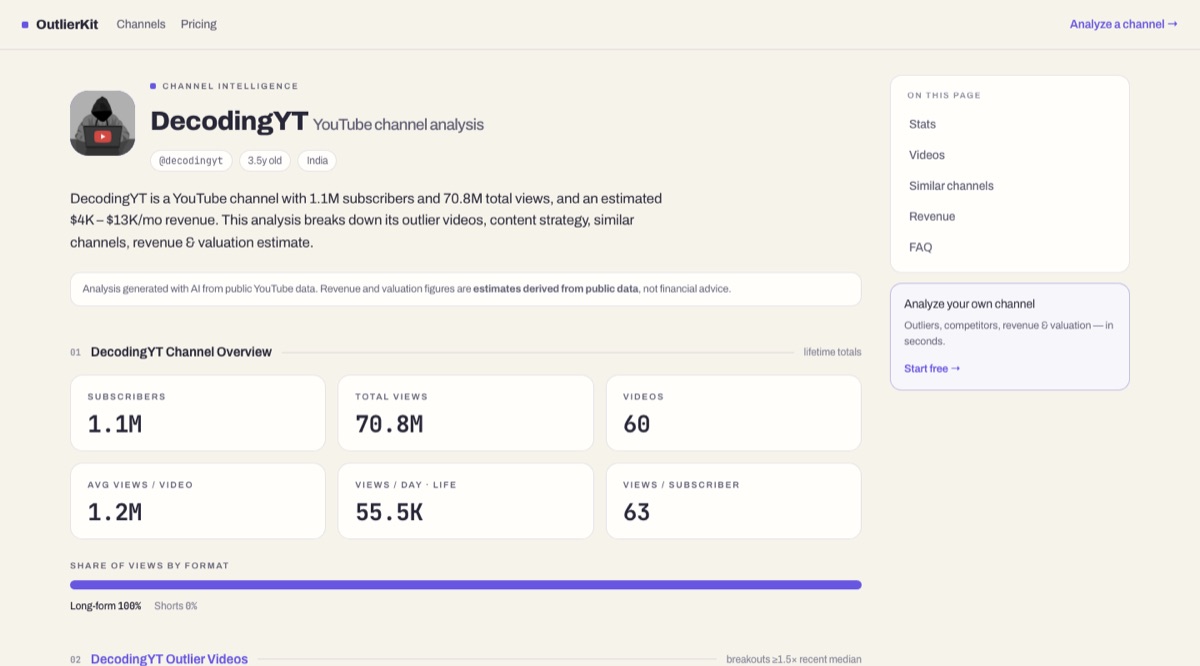
The live DecodingYT channel analysis on OutlierKit: living proof of the search-first playbook
Small Channels That Broke Out: Live Data
Before the 5-step strategy, look at the raw numbers behind channels that grew from nothing on a search-first playbook. Outlier videos, upload cadence, and revenue estimates are all included:
OutlierKit Channel Analysis

DecodingYT
YouTube growth education
- Subscribers
- 1.1M
- Avg views
- 1.2M
- Total views
- 70.8M
OutlierKit Channel Analysis

Recess Therapy
Kid-interview Shorts
- Subscribers
- 1.3M
- Avg views
- 708.7K
- Total views
- 658.4M
OutlierKit Channel Analysis

HuskyHacks
Cybersecurity
- Subscribers
- 17.5K
- Avg views
- 267.6K
- Total views
- 267.6K
OutlierKit Channel Analysis

Ryan McBeth
Military analysis
- Subscribers
- 1.1M
- Avg views
- 357.1K
- Total views
- 710.0M
Stats are from our most recent snapshot of each channel. For live numbers, outlier videos, and up-to-date revenue estimates, run a fresh analysis on OutlierKit →
The 5-Step Small Channel Strategy
Search traffic is the only source that doesn't care how many subscribers you have. Target long-tail keywords with real demand and beatable competition. Look for specific questions, comparisons, and how-tos the big channels ignore. Rank for twenty long-tail queries and you build a steady view floor. Browse-feed luck never gives you that.
The most common small-channel mistake is copying mega-channel tactics. Those tactics only work with mega-channel trust. Filter your competitor research to channels within roughly 10x of your size. Say a 5K-subscriber channel lands a 200K-view video. That packaging is proven to work without an existing audience behind it. That's the blueprint worth copying.
Write the title and describe the thumbnail before recording anything. At small scale you can't afford production hours on unclickable ideas. If the packaging isn't compelling on paper, the video doesn't get made. This one habit is borrowed from the biggest channels. It costs nothing and filters out most future flops.
YouTube actively tilted discovery toward small channels. The Hype feature lets viewers boost videos from creators under 500K subscribers onto a dedicated leaderboard. The 2026 browse-feed overhaul rewards niche viewer satisfaction over raw channel size. Ask for the Hype explicitly in your first 48 hours. It's the small-channel version of a share button that actually does something.
After 15-20 uploads, one or two videos will outperform your baseline 3x or more. That's your channel telling you what it wants to be. Make the sequel, the series, the deeper cut. The fastest small-channel growth curves all share one shape. First you run broad experiments. Then you commit hard to the first thing that worked.
What to Focus On at Each Milestone
| Stage | The one focus that matters |
|---|---|
| 0 → 100 subs | Pure search plays. Publish 8-12 keyword-validated videos to learn packaging basics. This gives the algorithm data about who you serve. |
| 100 → 1,000 subs | Find your outlier. Keep the search base and test 2-3 formats. Commit to whichever earns above-baseline CTR and retention. Monetization threshold: 1,000 subs + 4,000 watch hours. |
| 1,000 → 10,000 subs | Systematize the winner into a series. Layer in browse-oriented packaging, and start the 30-minute weekly research loop in earnest. |
| 10,000+ subs | Graduate to the full scaling system. That means expanding your formats and reinvesting in whatever the data says is working. |
Past 10K, the game changes. The 1K → 100K scaling system covers the next phase. The tactical subscriber checklist lives in the subscriber growth guide.
Channels That Broke Out From Small: Study These
The channels linked below all grew from nothing recently enough that their playbooks still apply. DecodingYT reached 1M subs from 60 search-first videos. Recess Therapy brought format innovation in Shorts. Ryan McBeth built explainer authority in a current-events niche. And if your goal is business results rather than view counts, HuskyHacks is the proof case to study: a solo operator that built B2B authority in a technical niche with this same search-first approach. Their live analyses show the exact outliers that powered each breakout.
Frequently Asked Questions
What is the best YouTube growth strategy for small channels in 2026?
Go search-first. Target long-tail, low-competition keywords with proven demand, because search traffic doesn't require an existing audience. Model packaging from outlier videos on channels near your own size. Write the title and thumbnail before producing. Use YouTube's Hype feature for early boosts, since it's available to channels under 500K subscribers. Then commit hard to your first internal outlier. Directional benchmark from our own channel teardowns, not a verified average: creators running this playbook commonly report reaching 1,000 subscribers in 4-8 months, while channels publishing on instinct often take 12-18 months or never get there.
What is the best YouTube growth strategy for beginners?
Beginners should optimize for learning speed, not subscriber count. Publish 8-12 keyword-validated videos to build packaging and retention fundamentals. Study 3-5 channels slightly ahead of you, not mega-channels. Treat every upload as an experiment with a hypothesis. Avoid the two classic beginner traps. The first is chasing saturated trends. The second is burning weeks perfecting videos on topics nobody searched for. The free-tool route works fine at this stage. Add data tooling once you're publishing consistently.
How does a new YouTube channel grow in 2026?
New channels grow through three doors in order. First is search, which is available immediately: rank for specific long-tail queries. Second is Shorts, which brings fast reach but weak subscriber conversion, so use it as a discovery layer. Third is browse and suggested, which the algorithm feeds once it has learned your audience from your first videos' satisfaction signals. A few 2026 specifics help new channels. The Hype leaderboard serves sub-500K creators. Browse-feed changes favor niche satisfaction. And auto-dubbing gives even tiny channels global reach.
Is the 2025 small-channel strategy still valid in 2026?
Yes. Search-first plus outlier modeling was the right 2025 strategy, and it still is. A few things changed in 2026. The browse feed now rewards tightly-focused channels sooner. Hype matured into a real discovery surface for small creators. And stricter low-effort-AI enforcement means quality-per-video matters more than upload volume. If anything, 2026 is friendlier to small channels than 2025 was.
How long does it take a small channel to reach 1,000 subscribers?
With keyword-validated topics and competitor-modeled packaging, a common range in our experience is 4-8 months. Treat that as directional, not a verified average. Publishing on instinct often stretches to 12-18 months. Many channels never get there. The variable that most separates the two groups isn't talent or gear. It's whether topic selection happens before or after production. For the tactical subscriber checklist, see our subscriber growth guide.

Related Guides
Find keywords a small channel can actually win
Keyword Research surfaces long-tail topics with real demand and beatable competition. It's the search-first strategy, automated.
Try OutlierKit Free